Bilbo Kills the Spider
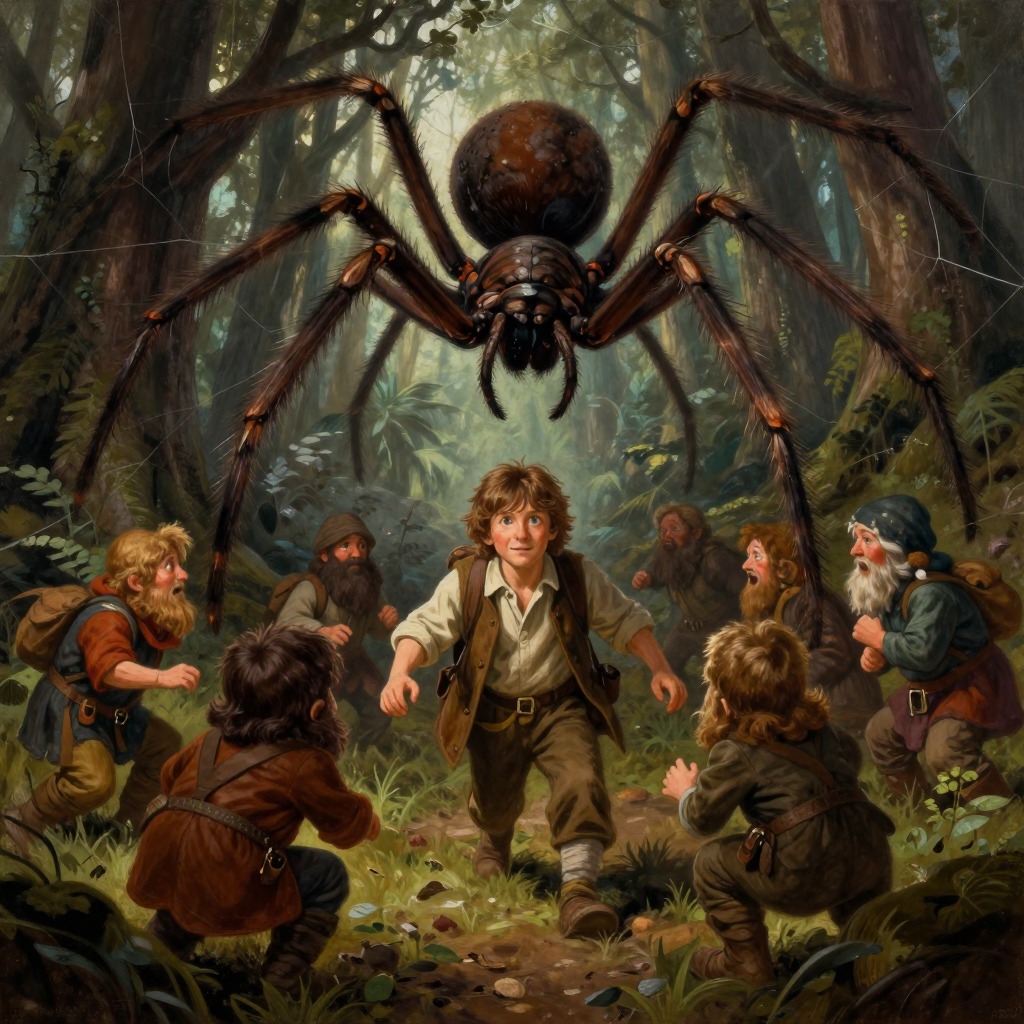
In the depths of Mirkwood, after the dwarves have been scattered by the Wood-elves' vanishing feast, Bilbo Baggins finds himself utterly alone in the pitch-dark forest. He sits down with his back to a tree, sinking into thoughts of his distant hobbit-hole and its well-stocked pantries, when he feels something touch him. A strong, sticky string wraps around his left hand, and he discovers his legs are already entangled; when he tries to stand, he falls over. The great spider that had been binding him while he dozed emerges from behind, and Bilbo can see only its eyes and feel its hairy legs as it struggles to wind its abominable threads around him. He beats the creature off with his hands—it is trying to poison him to keep him quiet, as small spiders do to flies—until he remembers his sword and draws it out. The spider jumps back, and Bilbo cuts his legs free. Then it is his turn to attack. The spider, evidently not used to things that carry such stings at their sides, hesitates, and Bilbo comes at it before it can disappear, stabbing it with his sword right in the eyes. The spider goes mad, leaping and dancing and flinging out its legs in horrible jerks, until Bilbo kills it with another stroke. Then he falls down and remembers nothing more for a long while.
The Killing and Its Immediate Aftermath
When Bilbo regains his senses, the usual dim grey light of the forest-day is around him. The spider lies dead beside him, and his sword-blade is stained black. The killing of the giant spider, all alone by himself in the dark without the help of the wizard or the dwarves or anyone else, makes a great difference to Mr. Baggins. He feels a different person, much fiercer and bolder in spite of an empty stomach, as he wipes his sword on the grass and puts it back into its sheath. This solitary victory is the first time Bilbo has overcome a significant threat entirely on his own, without Gandalf's magic or the dwarves' strength to back him. The act transforms his self-perception: he is no longer merely the hobbit who was carried and rescued, but someone capable of decisive, violent action.
Naming the Sword: Sting
After cleaning his blade, Bilbo speaks to it directly. "I will give you a name," he says, "and I shall call you Sting." This naming is a performative act that cements his new identity. The sword, which he had taken from the trolls' cave and which Elrond later identified as an elvish blade made in Gondolin for the Goblin-wars, now receives a personal name from its hobbit owner. The name "Sting" reflects both the weapon's size—a short sword for a hobbit, a mere knife for larger beings—and the manner of its use in this fight, where Bilbo stabbed the spider in the eyes. The naming also marks Bilbo's full acceptance of his role as a burglar and fighter; he is no longer a passive participant in the adventure but an active agent who claims his tools and his deeds.
Thematic Significance: The Tookish Side Emerges
This event is the culmination of a long-developing internal conflict within Bilbo. From the beginning of the tale, the narrator notes that Bilbo inherited "something a bit queer" from his mother's side, the Took family, which had a reputation for adventure and un-hobbitlike behavior. Earlier, in the goblin tunnels, Bilbo had felt a "sudden understanding, a pity mixed with horror" for Gollum, and had leaped over him rather than kill him. But in Mirkwood, alone and hungry, with no one to rely on, the Tookish side fully awakens. The killing of the spider is not an act of cruelty but of survival and self-assertion. It is the moment when Bilbo stops being the hobbit who wishes he were home and starts being the adventurer who can face the dragon. The naming of Sting also foreshadows his later role in the dragon's lair, where his small size and cleverness—his "sting"—will prove decisive. The event is a turning point in his maturation, and it earns him the respect of the dwarves, who had previously doubted his worth. When he later rescues them from the spiders, they bow to him, acknowledging that he has become the real leader of their company.